
Santa Cruz Branch Rail Line Corridor Climate Resilience Study
Study Overview
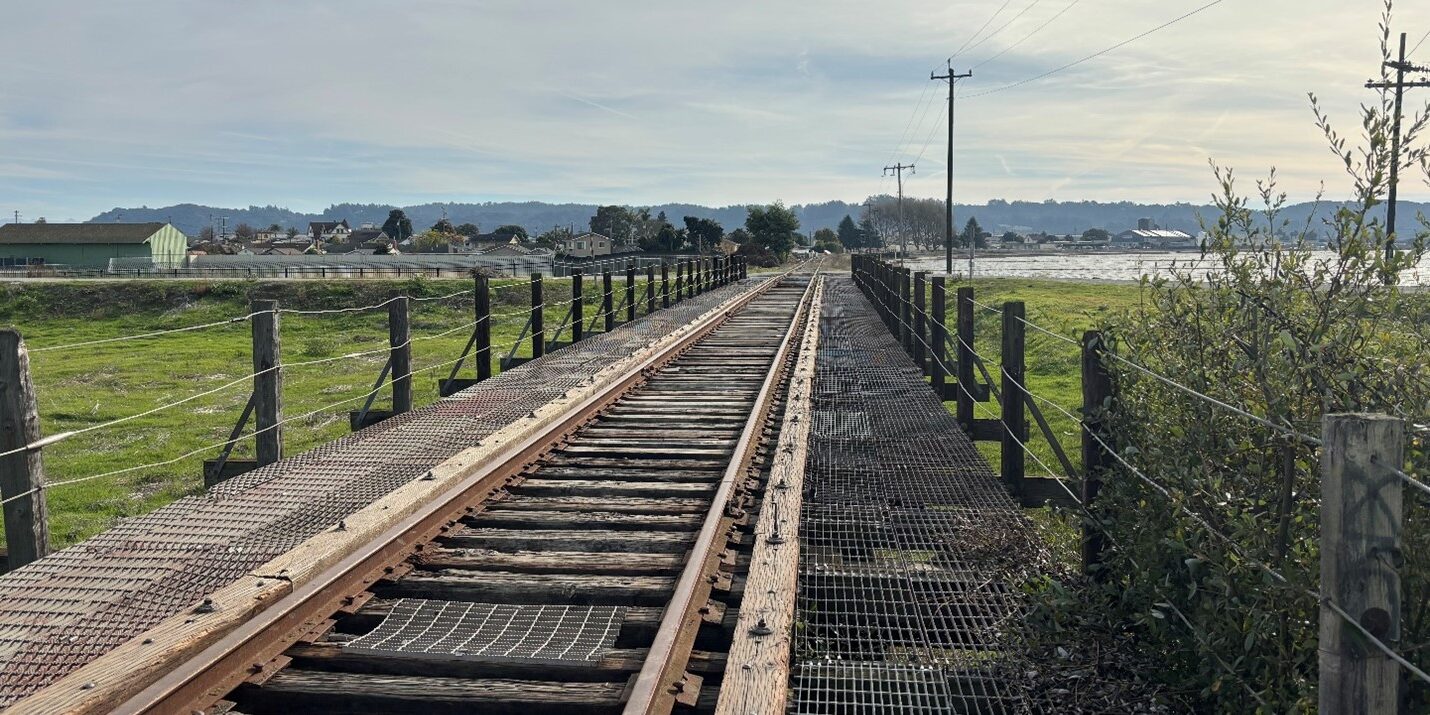
The Santa Cruz County Regional Transportation Commission (RTC) purchased the Santa Cruz Branch Rail Line (SCBRL) in 2012 to preserve as a future transportation corridor. The 32-mile corridor runs near or along the coast from Pajaro Junction to Santa Cruz and is proposed for passenger and freight rail, as well as bicycle and pedestrian trails.
The SCBRL corridor is vulnerable to climate change impacts. Like many communities along the California coast, Santa Cruz County is already facing significant and costly consequences from climate change and sea level rise. Stronger storms, rising tides, and coastal erosion are expected to intensify, requiring thoughtful planning to ensure the future use of our vital transportation corridors.
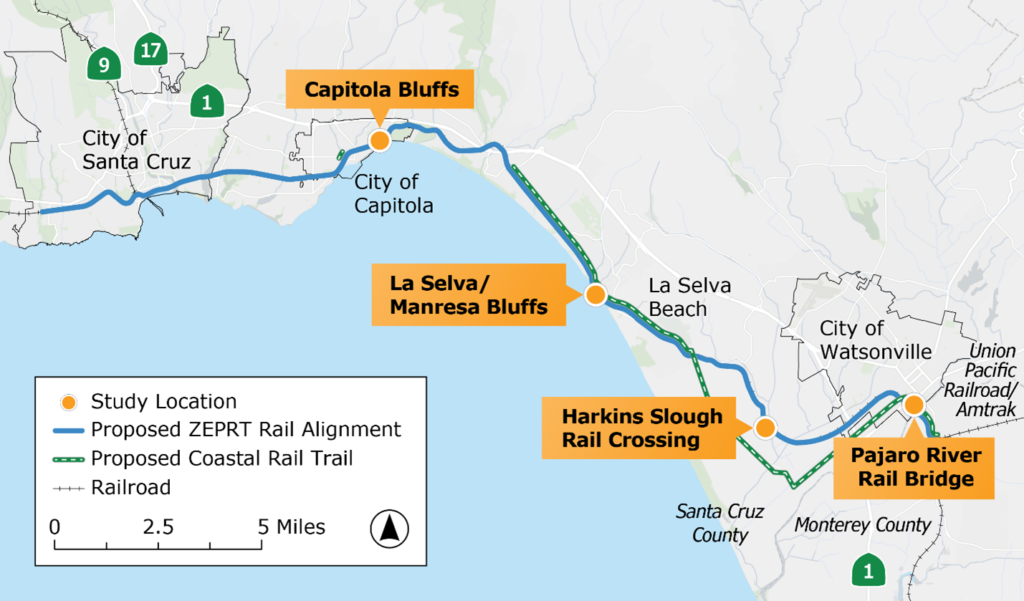
The RTC has initiated a climate resilience study for the SCBRL to understand potential impacts to future transportation uses, including an interim trail in the short term and passenger and freight rail alongside a trail in the long term. The Study, called the Zero Emission Passenger Rail and Trail (ZEPRT) Climate Resilience Study will assess climate stressors at four of the corridor’s most vulnerable locations (Capitola Bluffs, La Selva/Manresa Bluffs, Harkins Slough Rail Crossing and Pajaro River Rail Bridge) and will identify and recommend climate-resilient concepts for these locations. Concepts will be developed for short-, medium- and long-term climate projections.
To accommodate development of an interim trail, the study will evaluate concepts for trail-only alternatives at the three sites without active freight rail (Capitola Bluffs, La Selva/Manresa Bluffs, and Harkins Slough) for the short-term.
Scope of Study
The Study will identify and evaluate potential climate-resilient concepts and alignment alternatives in addition to those identified in the ZEPRT Project Concept Report for each of the four Study locations (additional vulnerable areas may be identified for future study but are not included at this time). This work will include:
- Use of the Caltrans Adaptation Framework and California State Sea Level Rise Guidance (2024) to assess existing conditions and climate stressors including sea level rise, storm surge, coastal erosion, flooding, and wildfire impacts.
- Development of concepts identifying and addressing needs for a resilient SCBRL corridor over various timeframes, which support eventual permitting requirements. Concepts could include (but are not limited to) rock slope protection, beach nourishment, or elevation or relocation of the rail and trail infrastructure. Concepts will be developed for use of the SCBRL as an interim trail in the short term and passenger and freight rail alongside a trail in the long term.
- Evaluation of the identified concepts based on a standard set of criteria to compare conceptual concepts at each site and inform decisions on which to move forward. Criteria may include measures such as resilience to coastal hazards, cost, environmental impacts, and public access and transportation benefits.
- Documentation of the concepts into a Draft Climate Resilience Plan, including a summary of the alternatives and their evaluation, next steps for implementation, and potential funding sources.
- Selection of recommended concepts that are cost-effective, technically robust, and support environmental protection, community access, and the region’s mobility objectives. The recommended concepts will be documented in the Final Climate Resilience Plan.
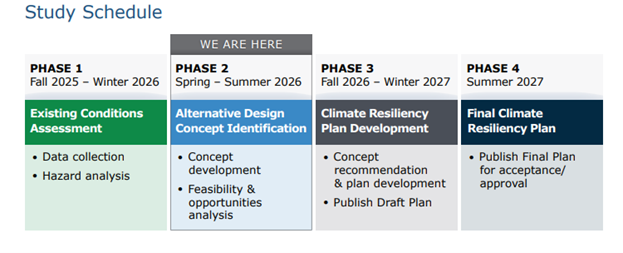
Study Schedule
The timeframe of each of the Study’s milestones is shown in the schedule below.
Resources
Engagement Opportunities
The RTC and its Study partners are committed to meaningful public and stakeholder engagement throughout the Study phases.
Stay tuned for more information on the engagement opportunities coming soon in Phase 3 (fall 2026).
Past Events
- May 27, 2026 Community Information Session (Phase 2): Provided an overview of the Study, climate hazards, proposed concepts to improve resiliency, how concepts will be evaluated, and next steps. Watch the recording here.
- June 9 & 10, 2026 In-Person Community Workshops (Phase 2): Workshops were held in Aptos and Watsonville. Shared a Study overview and gathered community feedback on climate stressors threatening the SCBRL corridor, resiliency concepts being considered, and evaluation criteria in relation to future transportation uses of the corridor. View the presentation materials here.
To stay informed about future engagement opportunities, sign up to be added to the Study mailing list and receive regular updates.
Stay Connected
 EMAIL
EMAIL

Email questions or comments to zeprtCR@sccrtc.org
MAILING LIST

Subscribe below to be added to the Study mailing list to receive regular updates and learn about future engagement opportunities.

PROJECTS
RTC Contact
Amanda Marino
Transportation Planner
zeprtCR@sccrtc.org
(831) 460-3200
Related News
Subscribe to our Mailing List
Latest news and up-to-date info delivered to your inbox
Report a Hazard
Notify us of obstacles or hazards that may inhibit travel.
